

Who Are the Guna? San Blas's Self-Governing People
The self-governing indigenous nation behind San Blas, its molas, and its rules for visitors
San Blas is technically part of Panama, but the land itself belongs to the Guna, and has for far longer than the name "San Blas" has been in use. The Guna govern their own territory, elect their own leaders, and set the rules for who can visit, what can be built, and how tourism works, right down to the entrance fee collected on each island. Understanding who they are makes the whole trip make more sense: why there are no resorts out here, why molas are everywhere, and why arriving feels like crossing into somewhere else entirely.
A Nation Within a Nation
The Guna, sometimes still written Kuna, call themselves Dule, meaning simply "people." Most live across three self-governing comarcas: Guna Yala, the archipelago most visitors mean when they say "San Blas," plus two smaller inland territories, Madugandí and Wargandí. Others live in Panama City, Colón, and a handful of villages just across the border in Colombia.
That self-governance was won, not given. Starting in 1919, Panama's government banned core parts of Guna life outright, mola blouses, nose rings, traditional dress, as part of a forced assimilation campaign. On February 22, 1925, Guna leaders Nele Kantule and Simral Colman led a coordinated uprising against Panamanian police stationed on the islands. It lasted only a few days, but with an American ally, Richard Marsh, helping broker U.S. mediation, it ended in a peace agreement recognizing Guna self-rule. The territory became a protected reserve in 1938, was formally established as a comarca in 1953, and was renamed from Kuna Yala to Guna Yala in 2011, when Panama's government accepted "Guna" as the more accurate spelling of how the word is actually said.

How the Guna Govern Themselves
Guna Yala has its own parliament, in effect. The Congreso General Guna, made up of representatives from every community, meets several times a year and is guided by three Saila Dummagan, or Great Sailas. On each island, a local saila leads the community's own congress from the onmaked nega, the gathering house, chanting the community's history and laws from memory rather than reading them from a book, a tradition that's as much spiritual practice as it is local government.
That structure is also why tourism here looks the way it does. In 1996, the Congreso General Guna passed a statute putting tourism entirely under Guna control: every hotel, cabin, and tour operation has to be Guna-owned and approved by the Congress, no exceptions, and no new large-scale developments have been approved since. Part of every visitor's entrance fee is split between the Congress and the community whose island you're on, so day-to-day, tourism income stays with the people actually hosting you rather than an outside company.
Read how to actually visit: island stay vs. sailboat charter
#
Everyday Life on the Islands
Guna society is matrilineal and matrilocal: when a couple marries, it's typically the husband who moves into his wife's family home, not the other way around, and family lines are traced through the mother's side. It's a quiet detail that shapes a lot of what a visitor sees, family compounds built around women, who are often the ones running the household economy.
Fishing, small-scale farming on mainland plots across from the islands, and coconuts make up the traditional backbone of island life, coconuts especially: for generations they functioned almost like currency, traded directly with Colombian schooners that would sail in to buy them. Today that trade continues alongside two newer income sources: molas, which for many families are now the main source of cash income, and tourism itself.
Molas: Everyday Art You Can Wear
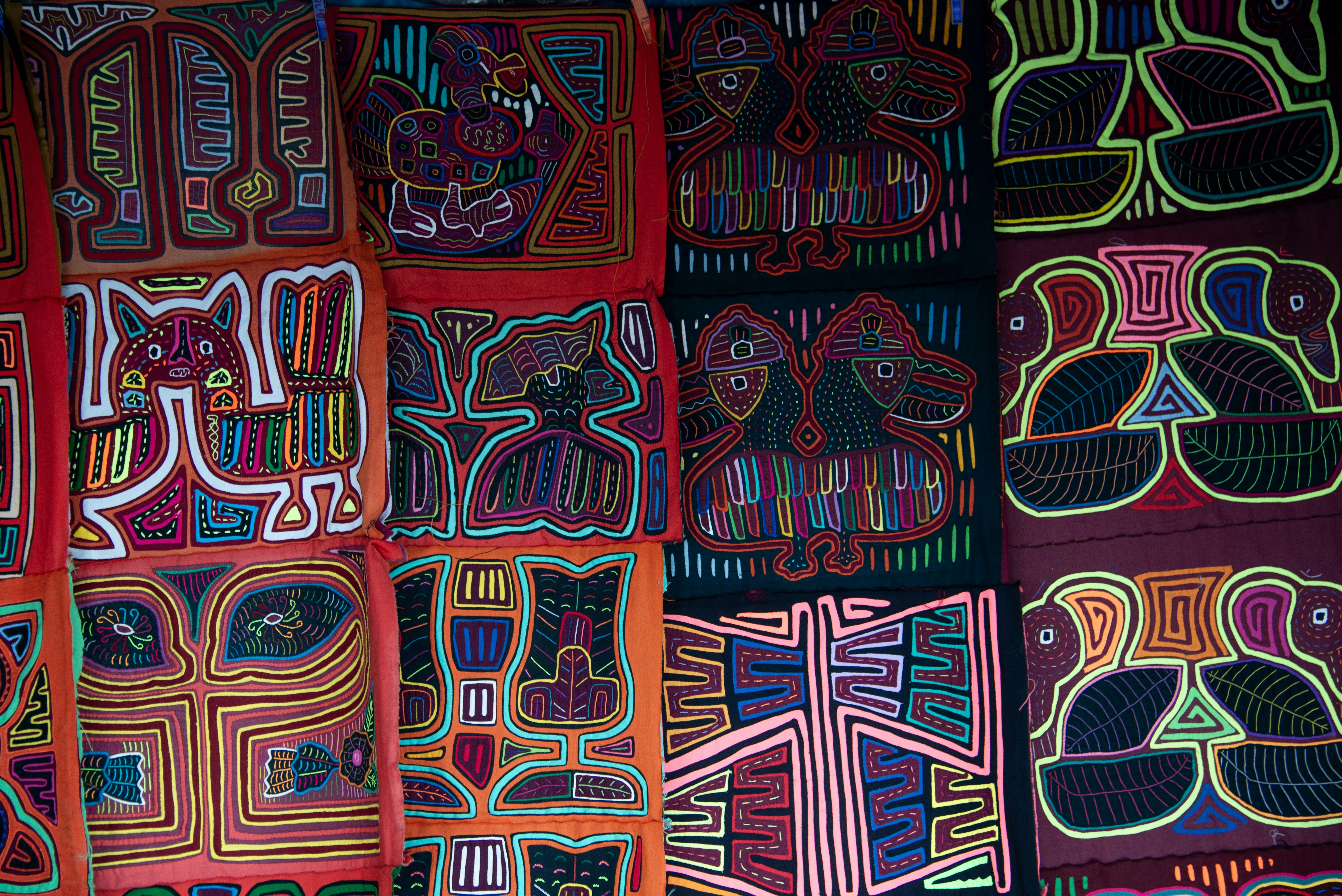 Photo: Maria Molino (Unsplash)
A mola is a panel of fabric, usually one of a matching pair sewn into the front and back of a woman's blouse, made using reverse appliqué: two to seven layers of colored cloth stacked together, then cut away layer by layer so the pattern reveals the color underneath. A detailed one can take a woman weeks, sometimes months, to finish by hand.
The oldest designs are geometric, descended from patterns Guna women once painted directly onto their bodies. Newer ones borrow from anywhere, political posters, book illustrations, even cartoons, alongside traditional animal and spirit motifs. Molas aren't just decoration: they were one of the very things Panama's government tried to ban in 1919, which makes them part of what the 1925 revolution was actually fought over. Buying one directly from the woman who made it, rather than through an outside shop, is both the more honest way to buy one and the way the money is most likely to stay with her.

Dress, Language and Belief
Guna women's everyday dress is distinctive: a mola blouse, a wrapped skirt called a saburet, a red-and-yellow headscarf, a gold nose ring, and winis, tightly wound beadwork that spirals up the forearms and calves in narrow, deliberate bands. Guna men, by contrast, mostly wear ordinary Western clothing today.
The Guna language, Dulegaya, is still spoken by an estimated 50,000 to 70,000 people and belongs to the Chibchan language family, native to lower Central America and Colombia. One detail visitors sometimes notice and ask about: Guna communities have an unusually high rate of albinism, and albino Guna have traditionally held a distinct, respected place in the community's spiritual life rather than being treated as an anomaly.
A Changing Coastline
San Blas's islands sit barely above sea level, and some are already feeling it. In 2024, around 300 families from Gardi Sugdub, one of the most crowded islands in the archipelago, completed a move to Isber Yala, a new village built for them on the nearby mainland, Panama's first community relocation attributed to climate change. Not everyone on the island agreed with that framing; some longtime residents point out that Gardi Sugdub has actually grown over the decades through land reclamation and survived past disasters without leaving. Either way, it's a preview of a conversation more islands in the archipelago are likely to have.
Meeting the Guna as a Visitor
Good to Know
A few things worth knowing before you go: always ask before photographing anyone, Guna communities tend to be reserved rather than performative for visitors. Buy molas directly from the women selling them where you can. Keep noise down near villages. And carry cash: the entrance fee charged per island is small, but it's also how the money you're spending here actually reaches the community hosting you.
Read our full San Blas sailboat trip report
#
The Guna People — FAQ


Did this guide help you?
Your feedback helps us make KUNO better.
🍪 Cookie Notice
We use cookies to improve the KUNO guide experience and understand how visitors use the platform. Privacy Policy